The “Protein Revolution” in Indian Poultry: How Blood-Rumen Mixtures Can Slash Your Feed Costs
In the Indian poultry industry, feed is the single largest expense, often swallowing up to 70-80% of total production costs. With the prices of conventional ingredients like soybean meal and fishmeal skyrocketing, Indian farmers and integrators are caught in a “margin squeeze.” To stay profitable, the industry is shifting its focus toward sustainable poultry feed in India.
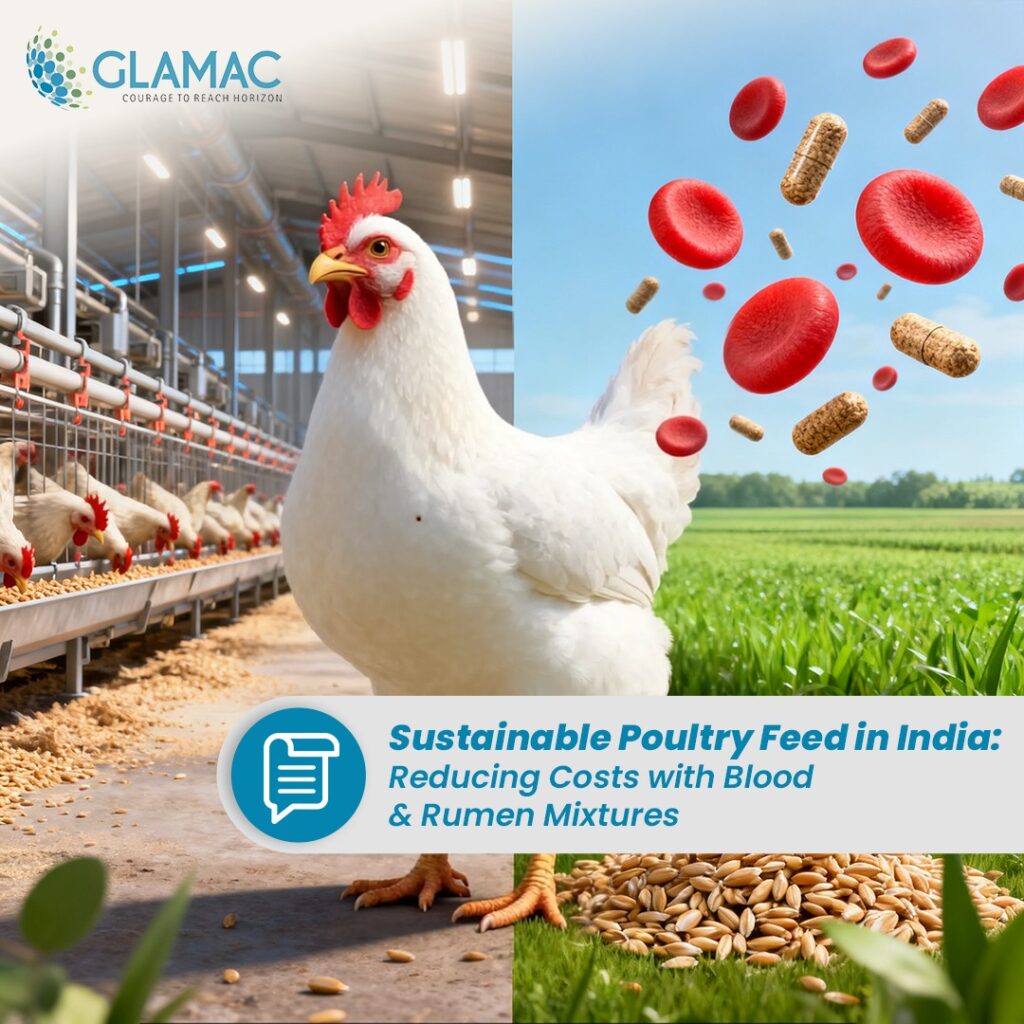
One of the most promising breakthroughs is the utilization of slaughterhouse by-products—specifically Dried Blood-Rumen Content Mixtures (DBRCM). This “waste-to-wealth” approach not only offers a high-protein alternative but also addresses environmental challenges, making it a game-changer for veterinarians and feed manufacturers across the country.
What is DBRCM? The Nutritional Powerhouse
Dried Blood-Rumen Content Mixture (DBRCM) is a balanced blend of two potent abattoir by-products:
- Dried Blood Meal (DBM): The Protein Engine
Dried blood is a concentrated nutritional powerhouse, boasting a crude protein content of 80% to 90%.
- Amino Acid Profile: It is exceptionally rich in lysine (7.2%-8.5%) and methionine, which are critical for muscle development and rapid growth in broilers.
- Iron Content: With iron levels reaching 2000-3000 mg/kg, it effectively prevents anemia and supports hemoglobin synthesis in high-yielding birds.
- Rumen Content: The Gut Health Booster
Extracted from ruminants, this material is rich in fiber, nitrogenous compounds, and microbial biomass.
- Prebiotic Potential: The microbial mass acts as a natural probiotic, enhancing gut motility and nurturing healthy intestinal flora.
- Dietary Fiber: It contains 42%-48% Neutral Detergent Fiber (NDF), which helps slow down digestion for better nutrient absorption.
Nutritional Comparison: DBRCM vs. Conventional Feed
To understand why you should consider this alternative, look at how it stacks up against traditional (and expensive) protein sources.
Table 1: Nutritional Profile Comparison
| Nutrient Parameter | Soybean Meal | Fishmeal | Dried Blood Meal (DBM) | Rumen Content |
| Crude Protein (%) | 44 – 48% | 60 – 70% | 80 – 90% | 12 – 14% |
| Lysine (% of protein) | ~6.3% | ~7.5% | 7.2 – 8.5% | – |
| Iron (mg/kg) | Low | Moderate | 2000 – 3200 | Moderate |
| Crude Fiber/NDF (%) | ~7% | <1% | Negligible (<0.5%) | 42 – 48% |
| Cost Profile | High ($400-$600/ton) | Very High ($1200-$1800/ton) | Low ($500-$800/ton) | Low (Waste Product) |
Practical Application: Dosage and Inclusion Rates
For Indian poultry farmers, the “golden rule” is balance. You cannot simply replace all feed with DBRCM; it must be strategically integrated.
For Broilers (Growth Focus)
- Optimal Level: Inclusion of 5%-10% is recommended.
- Benefits: Strategic use improves the Feed Conversion Ratio (FCR), enhances carcass quality, and speeds up muscle building.
- Risk: Exceeding 10% can reduce palatability and lead to amino acid imbalances due to excessive lysine.
For Layers (Egg Production Focus)
- Optimal Level: A moderate inclusion of 3%-7%.
- Benefits: Supports consistent egg formation while the fiber content enhances overall gut health and feed efficiency.
The Economic Impact: Increasing Farmer Profitability
In developing agricultural hubs like India, reducing reliance on expensive imports is vital.
- Direct Cost Savings: Integrating DBRCM can reduce overall feed costs by 15% to 30%.
- Waste Management: India generates millions of tons of abattoir waste annually. Repurposing this “waste” into feed reduces disposal costs and creates a circular economy.
Critical Challenges: Safety and Palatability
While the benefits are clear, the Indian poultry sector must address two major hurdles to ensure poultry feed management success:
-
Pathogen Control
Raw slaughterhouse by-products often carry Salmonella and E. coli.
- The Solution: Standard processing must include high-temperature treatment ($\ge 100^\circ C$ for 30 min) and drying to a moisture level below 10% to ensure biosafety.
-
Overcoming “Off-Flavors”
Poultry can be deterred by the metallic or earthy smell of blood and rumen.
- The Solution: Using natural flavorings like vanilla, citrus, or herbal extracts can mask these odors, ensuring consistent feed intake.
Conclusion: The Path Forward for India
The adoption of Dried Blood-Rumen Content Mixtures represents a significant step toward a more resilient and sustainable poultry feed industry in India. By turning environmental hazards (abattoir waste) into high-value nutrients, we can protect farmer margins, improve bird health, and reduce our ecological footprint.
For large-scale adoption, we need increased investment in local processing technologies and specialized training for farmers to manage these alternative diets effectively.
References
- Shuma, S., Senbeta, D. H., & Petunia, M. D. (2025). Dried Blood-Rumen Content Mixtures as Sustainable Poultry Feed: A Review on Nutritional, Economic, and Environmental Potential. Food Science & Nutrition.
- FAO (2023). The State of Food and Agriculture: Revealing the True Cost of Food.
- Martinez-Perez, D., et al. (2023). Nutritional Impacts on Growth Performance.