Flight toward Sustainability in Poultry Nutrition with Black Soldier Fly Larvae
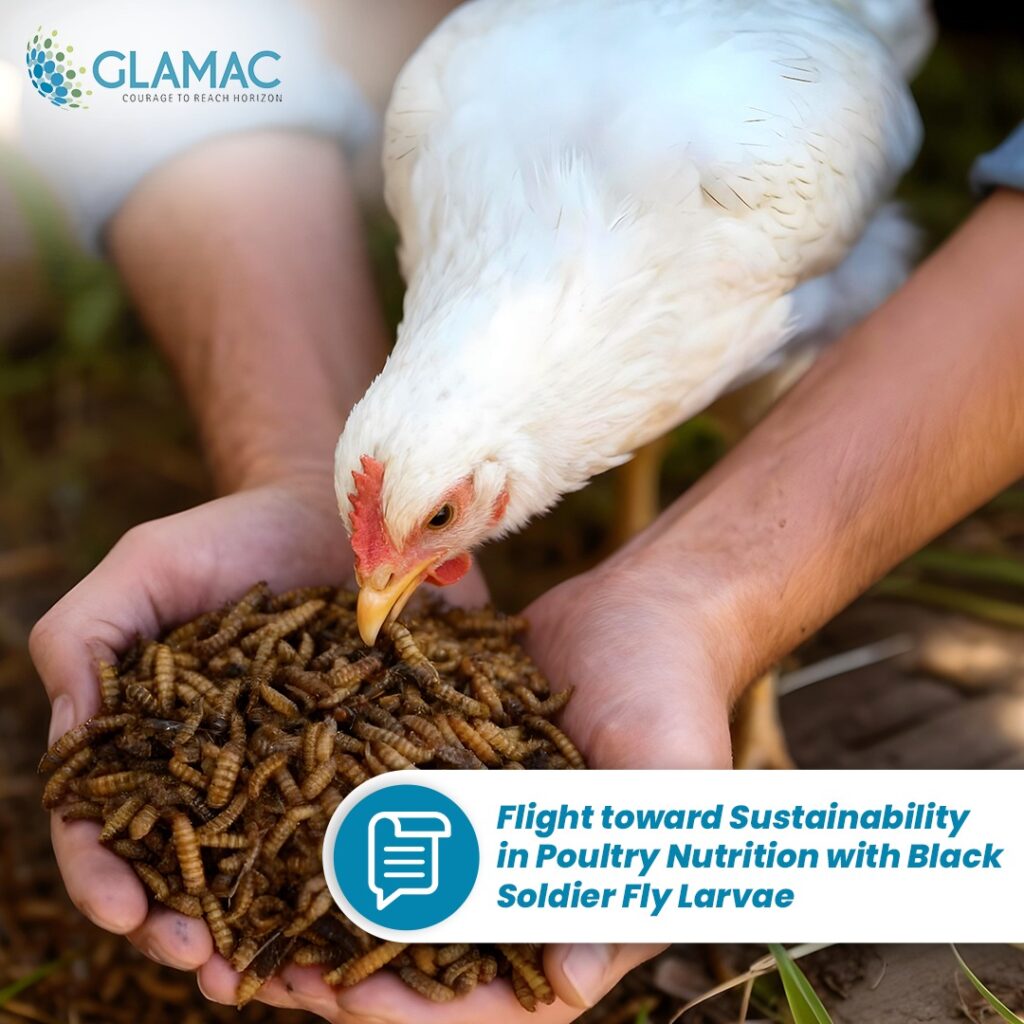
The future of poultry nutrition depends on sustainability. Conventional protein sources like soybean meal and fishmeal, though nutritionally rich, are becoming unsustainable due to their environmental footprint, price volatility, and competition with human food sources.
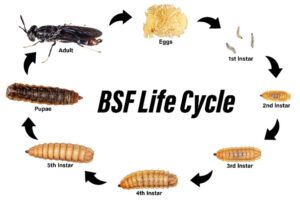
Enter the Black Soldier Fly Larvae (BSFL, Hermetia illucens) — a revolutionary feed ingredient that turns organic waste into nutrient-dense biomass. With its high protein, beneficial fats, and bioactive compounds, BSFL presents a sustainable solution to modern poultry feeding challenges.
- Nutritional Composition of BSFL
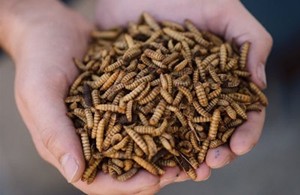
The nutrient profile of BSFL varies depending on the substrate used for rearing and the degree of fat extraction. Overall, BSFL provides a balanced amino-acid profile comparable to soybean meal and fishmeal.
| Component | BSFL (Defatted) | BSFL (Full-fat) | Soybean Meal | Fishmeal |
| Crude Protein (%) | 45–55 | 32–45 | 44–48 | 55–65 |
| Crude Fat (%) | 10–15 | 25–35 | 1–2 | 8–12 |
| Crude Fiber (%) | 6–8 | 6–8 | 5–7 | 1–2 |
| Ash (%) | 9–14 | 8–12 | 6–7 | 18–22 |
| Calcium (%) | 5.5–9.0 | 4.5–8.0 | 0.3 | 5.0 |
| Phosphorus (%) | 0.6–1.5 | 0.7–1.3 | 0.6 | 3.2 |
Source: Salahuddin et al. (2024), Animals 14(510); Diener et al. (2015)
Key Insight:
BSFL offers high-quality protein and minerals—especially calcium and phosphorus—making it a strong candidate for broiler and layer diets. Its high lauric acid content also improves gut health.
- Fatty-Acid Profile and Functional Benefits
The fat content in BSFL provides more than just energy. It includes medium-chain fatty acids (MCFAs)—notably lauric acid—which have antimicrobial and immune-boosting effects.
| Fatty Acid | BSFL (%) | Soybean Oil (%) | Fish Oil (%) | Functional Benefit |
| Lauric acid (C12:0) | 28–40 | <0.1 | <0.1 | Antimicrobial, gut protection |
| Palmitic acid (C16:0) | 15–18 | 10–12 | 16–20 | Energy source |
| Oleic acid (C18:1) | 18–25 | 25–35 | 13–18 | Improves meat juiciness |
| Linoleic acid (C18:2) | 7–10 | 45–55 | 3–5 | Essential PUFA for growth |
| Stearic acid (C18:0) | 6–8 | 3–5 | 3–4 | Stabilizes lipid membranes |
Source: Salahuddin et al., 2024; Cullere et al., 2019
Key Insight:
High lauric acid in BSFL fat acts as a natural antibiotic alternative, improving feed conversion and disease resistance in poultry.
- Performance of Broilers Fed with BSFL Meal
Experimental results demonstrate that partial replacement of soybean meal (up to 10%) with BSFL meal improves broiler growth performance and feed efficiency without adverse effects.
| Inclusion Level of BSFL | Body Weight Gain (g/bird) | Feed Conversion Ratio (FCR) | Mortality (%) | Observation |
| 0% (Control) | 2250 | 1.72 | 2.0 | Standard soybean-based diet |
| 5% | 2305 | 1.69 | 1.8 | Improved digestibility and immunity |
| 10% | 2328 | 1.68 | 1.5 | Best performance, enhanced feed efficiency |
| 15% | 2280 | 1.74 | 2.1 | Slight drop; higher chitin reduces digestibility |
| 20% | 2200 | 1.78 | 2.5 | Performance declines beyond optimal inclusion |
Source: Salahuddin et al., 2024; Biasato et al., 2019
Key Insight:
An inclusion rate of 5–10% BSFL meal in poultry diets is optimal for balancing performance, cost, and health benefits.
- Health and Immunity Enhancements
BSFL contains bioactive molecules—chitin, lauric acid, and antimicrobial peptides—which support gut integrity and immune functions.
Benefits observed in broiler studies:
- Increased villus height and mucin secretion in intestines
- Higher lysozyme and IgA levels, improving pathogen resistance
- Reduction in gut pathogens (E. coli, Salmonella spp.)
- Improved gut microbiota balance, favoring Lactobacillus spp.
These effects make BSFL a powerful natural tool to reduce antibiotic dependence in poultry farming.
- Sustainability and Environmental Benefits
BSFL farming aligns with circular economy principles, converting organic waste into valuable biomass.
| Parameter | Soybean Meal | Fishmeal | BSFL Meal |
| Land use (m²/kg protein) | 6.6 | 4.5 | 1.2 |
| Water use (L/kg protein) | 1800 | 900 | 450 |
| CO₂ emissions (kg CO₂-eq/kg protein) | 6.2 | 13.5 | 2.3 |
| Waste utilization | None | None | Up to 60% organic waste recycled |
Source: Salahuddin et al., 2024; FAO Life Cycle Assessment Data, 2022
Key Insight:
BSFL reduces land, water, and carbon footprints drastically—making it an eco-friendly, future-ready feed ingredient.
Conclusion
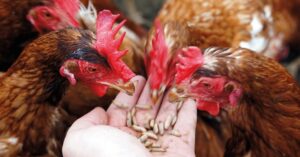
Black Soldier Fly Larvae (BSFL) are not merely an alternative—they represent the future of sustainable poultry nutrition. Their superior nutritional profile, antimicrobial benefits, and waste-reduction capacity offer a holistic solution for both productivity and environmental stewardship.
When incorporated at 5–10% inclusion levels, BSFL meal improves growth performance, meat quality, and immunity in broilers without compromising sustainability.
Adopting BSFL-based feeds is not just a step toward better poultry—it’s a flight toward a greener planet.
References
- Salahuddin M., Abdel-Wareth A.A.A., Hiramatsu K., Tomberlin J.K., Luza D., & Lohakare J. (2024). Flight toward Sustainability in Poultry Nutrition with Black Soldier Fly Larvae. Animals, 14(510). https://doi.org/10.3390/ani14030510
- Cullere M., Dabbou S., Tasoniero G., et al. (2019). Black soldier fly as alternative protein in poultry diets. Poultry Science, 98(12), 5779–5787.
- Biasato I. et al. (2019). Insect meal inclusion on broiler growth and gut health. Animal Feed Science and Technology, 256, 114–125.
- Diener S., Zurbrügg C., & Tockner K. (2015). Conversion of organic waste into animal feed via black soldier fly larvae. Waste Management, 35, 66–72.
- FAO (2022). Life Cycle Assessment Data for Feed Ingredients: Global Feed Sustainability Index.