From Raw Grains to Balanced Rations: Why Analytical Chemistry Governs Modern Poultry Farming
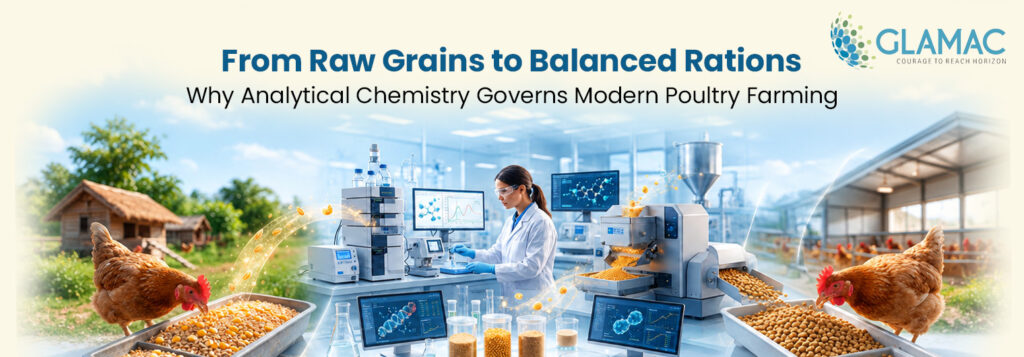
In modern poultry production, feed represents 65% to 75% of total operating expenses. Every decimal variation in raw material composition directly shapes flock Feed Conversion Ratio (FCR), uniform weight gain, and flock liveability. Simultaneously, the poultry sector operates under tight economic pressure alongside strict food safety and biosecurity mandates.
Poultry feed is not a static mixture; it is a complex biochemical matrix. Slight deviations in moisture, amino acid availability, or lipid oxidation, as well as invisible contaminants like mycotoxins, pesticide residues, and heavy metals, can impair enteric integrity, cause immunosuppression, or leave chemical residues in commercial eggs and dressed broiler meat.
This is where analytical chemistry in poultry feed transitions from an academic discipline into an operational necessity. Analytical chemistry equips nutritionists, quality assurance managers, veterinarians, and integrators with the tools to quantify raw ingredients, detect micro-pollutants, and ensure compliance with food safety regulations.
The Three Pillars of Chemical Analysis in Poultry Science
Analytical chemistry examines individual compounds and complex chemical mixtures. In poultry nutrition and diagnostics, it operates across three foundational branches:
- Quantitative Analysis: Measures the exact concentration or percentage of specific components within feedstuffs or avian tissues. Examples include determining crude protein (CP%), calcium, total phosphorus, and available synthetic amino acids (lysine, methionine).
- Qualitative Analysis: Identifies whether a target substance is present or absent within a sample matrix. This includes screening incoming maize batches for aflatoxin presence or checking premixes for prohibited non-protein nitrogen compounds.
- Structural Analysis: Elucidates the internal atomic connectivity, stereochemistry, and functional molecular architecture of compounds. This is critical for evaluating vitamin isomer stability, bioavailability of chelated organic trace minerals, and synthesized feed enzymes (such as phytase or xylanase).
Protecting the Food Chain: Contaminant and Residue Profiling
The entry of undesirable chemical agents into raw feed ingredients compromises bird health and risks chemical “carry-over” into poultry products destined for human consumption. Left unmanaged, this same background pathogen and toxin load can impair enteric integrity, cause immunosuppression, or leave chemical residues in commercial eggs and meat. Analytical chemistry enables proactive screening of the key contaminant classes:
1. Mycotoxins and Fungal Metabolites
Molds such as Aspergillus, Penicillium, and Fusarium produce hazardous fungal metabolites under favorable humidity and temperature conditions. Beyond lethal acute toxicities, chronic ingestion of low-level mycotoxins — including aflatoxins, trichothecenes, zearalenone, fumonisins, ochratoxin A, and ergot alkaloids — erodes gut villi, impairs nutrient absorption, causes severe oral lesions, and triggers vaccine failures.
2. Veterinary Drug Residues and Cross-Contamination
While therapeutic antibiotics and coccidiostats protect gut health, failure to respect withdrawal periods or cross-contamination in automated feed mixing lines can lead to illegal chemical residues in commercial meat and eggs.
Coupling liquid chromatography with mass spectrometry (LC-MS) permits trace quantification of drug residues, helping farms avoid residue violations and slow the development of antimicrobial resistance (AMR).
3. Persistent Environmental Pollutants (Dioxins & PCBs)
Polychlorinated dibenzo-p-dioxins (PCDDs), polychlorinated dibenzofurans (PCDFs), and polychlorinated biphenyls (PCBs) represent lipophilic environmental contaminants that accumulate in bird fat and yolk tissue. Because toxicities vary widely across different congeners, analytical protocols measure them against 2,3,7,8-tetrachlorodibenzodioxin (2,3,7,8-TCDD) using Toxic Equivalency Factors (TEFs) to calculate total Toxic Equivalents (TEQ).
4. Heavy Metals and Toxic Elements
Arsenic, cadmium, lead, nickel, and mercury leach into feed chains via contaminated mineral sources (such as low-grade dicalcium phosphate), untreated groundwater, or adulterated agricultural byproducts. Analytical chemistry monitors both total elemental loads and specific chemical valencies (e.g., distinguishing toxic inorganic arsenic from organic forms).
Analytical Methodologies Applied in Poultry Science
Modern analytical laboratories utilize classical wet chemistry alongside advanced instrumental platforms to evaluate feed safety, ingredient potency, and biological residues. The table below maps each technique to what it measures and why it matters on a working poultry farm:
| Analytical Technique | Primary Poultry Application | Target Analytes / Components | Practical Operational Benefit |
|---|---|---|---|
| Kjeldahl Digestion & Distillation | Crude protein determination | Total nitrogen in raw grains and finished feeds | Basic verification of protein levels in soymeal, rapeseed meal, and finished mash/pellets. |
| Atomic Absorption Spectrophotometry (AAS) | Mineral and electrolyte profiling | Ca, P, Mg, Na, K, Cu, Zn, Mn, Fe | Prevents nutritional rickets, ensures bone integrity, and maintains dietary electrolyte balance (DEB). |
| Inductively Coupled Plasma Mass Spectrometry (ICP-MS) | Trace xenobiotics & heavy metal screening | Lead (Pb), Arsenic (As), Cadmium (Cd), Mercury (Hg) | Offers sub-ppb sensitivity to detect toxic industrial elements in mineral premixes. |
| Liquid Chromatography–Mass Spectrometry (LC-MS/MS) | Drug residue & multi-mycotoxin analysis | Aflatoxins, DON, Ochratoxin A, antibiotic residues, coccidiostats | High-specificity multi-analyte quantification; resolves cross-contamination risks. |
| High-Performance Liquid Chromatography (HPLC-FLD/UV) | Synthetic amino acids & vitamin stability | Lysine, Methionine, Threonine; fat/water-soluble vitamins | Verifies premix blending uniformity and active vitamin potencies post-pelleting. |
| Near-Infrared Spectroscopy (NIRS) | Rapid on-site raw material scanning | Moisture, crude fat, crude fiber, protein, starch | Provides non-destructive, 60-second nutrient profiling for rapid ingredient intake decisions. |
Rigorous Quality Control: The Crucial Role of Method Validation
An analytical instrument is only as reliable as the standard operating procedures that govern it. To establish legal and nutritional confidence, feed testing protocols must be thoroughly validated across these fundamental analytical performance parameters:
- Selectivity / Specificity: Confirming the analytical method measures the target analyte without interference from other feed matrix components.
- Limit of Detection (LOD): The lowest quantity of an analyte that can be reliably distinguished from analytical background noise.
- Limit of Quantification (LOQ): The minimum concentration at which an analyte can be measured with acceptable precision and accuracy.
- Working Range & Linearity: Demonstrating that analytical responses remain directly proportional to analyte concentration across a specified operational span.
- Sensitivity: The degree of change in instrument signal relative to a corresponding change in target compound concentration.
- Precision & Repeatability: The degree of agreement among independent test results obtained under identical operating conditions over brief time intervals.
- Accuracy & Recovery: Measuring the closeness between obtained experimental values and true certified standard reference materials, accounting for matrix extraction losses.
Representative Sampling: The Foundation of Valid Analysis
Analytical findings are only as representative as the initial sampling protocol. Testing errors often originate in the field rather than the instrument laboratory.
Grains and finished feeds stored in bulk silos, deep godowns, or high-capacity mixing hoppers display natural physical segregation, moisture gradients, and localized hot spots of mold growth.
- Samples must be gathered across multiple vertical and horizontal depths using calibrated grain probes and triers.
- Multiple primary samples should be combined, systematically homogenized, and reduced through riffling or quartering into official reference lots.
- Following standardized regulatory frameworks (such as Codex Alimentarius or official sampling standards) prevents commercial testing disputes between feed millers and ingredient suppliers.
Formulating Functional Diets and Protecting Production Value
Beyond screening for toxic risks, analytical chemistry enables precision nutrition. Feed formulation is transitioning from gross nutrient estimates to dynamic molecular balancing:
- Custom Fatty Acid Profiling: Optimizing the ratio of omega-6 to omega-3 essential fatty acids enables the development of value-added, cholesterol-conscious, nutrient-enriched table eggs.
- Bioavailability and Enzyme Matrix Tuning: Precise quantification of non-starch polysaccharides (NSPs) and phytate-bound phosphorus ensures accurate exogenous enzyme inclusion rates (xylanases, beta-glucanases, phytases), cutting inorganic phosphorus supplementation costs and mitigating environmental discharge.
- Digestible Amino Acid Balance: Shifting from crude protein targets to standardized ileal digestible (SID) amino acid ratios minimizes dietary excesses, limits enteric stress, and cuts nitrogenous uric acid output in poultry litter.
Securing the Future of Poultry Production
Analytical chemistry is foundational to modern poultry science. As commercial production scales and margins require greater precision, guessing ingredient inputs is no longer viable.
Implementing analytical chemistry across incoming grain testing, water screening, and finished feed verification protects flock gastrointestinal health, improves FCR, prevents devastating contaminant outbreaks, and ensures consumer confidence in commercial poultry products.
Frequently Asked Questions
What is the role of analytical chemistry in poultry feed testing?
It gives nutritionists and QA teams the tools to quantify raw ingredients, detect micro-pollutants such as mycotoxins and heavy metals, and confirm compliance with food safety regulations before feed reaches the bird.
Which analytical techniques detect mycotoxins in poultry feed?
Advanced chromatographic assays, particularly LC-MS/MS, detect mycotoxins such as aflatoxins, DON, and ochratoxin A at trace parts-per-billion levels before compromised grain enters the feed mill.
Why does the sampling method matter as much as the lab test itself?
Bulk silos and mixing hoppers show natural segregation and moisture gradients, so a single, poorly placed sample can misrepresent the whole lot. Multi-depth sampling, homogenization, and standardized reduction (riffling/quartering) are what make the resulting lab result trustworthy.
References
- Harvey, D. (2000). Modern Analytical Chemistry. McGraw-Hill Higher Education, New York.
- Zaefarian, F., Cowieson, A. J., Pontoppidan, K., Abdollahi, M. R., and Ravindran, V. (2021). Trends in feed evaluation for poultry with emphasis on in vitro techniques. Animal Nutrition, 2: 268–281.
- Bernard, A., Broeckaert, F., De Poorter, G., De Cock, A., Hermans, C., and Saegerman, C. (2002). The Belgian PCB/dioxin incident: Analysis of the food chain contamination and health risk evaluation. Environmental Research, 88: 1–18.
- Hibbert, D. B. (1999). Method validation of modern analytical techniques. Accreditation and Quality Assurance, 4: 352–356.
- Monbaliu, S., Van Poucke, C., Detavernier, C., Dumoulin, F., Van De Velde, M., Schoeters, E., et al. (2010). Occurrence of mycotoxins in feed as analyzed by a multi-mycotoxin LC-MS/MS method. Journal of Agricultural and Food Chemistry, 58: 66–71.