The Silent Profit Killer: Oxidative Stress in Indian Poultry
In the rapidly evolving landscape of the Indian poultry industry, staying ahead means more than just providing feed and water. With India being one of the world’s largest producers of eggs and broiler meat, the pressure on farmers and integrators to maintain high growth rates and feed efficiency is immense.
However, a hidden biological challenge often stands in the way of peak performance: Oxidative Stress (OS). Especially in India’s tropical climate, where high temperatures and humidity are the norm, chickens are frequently pushed beyond their physiological limits. This blog explores what oxidative stress is, how it drains your farm’s ROI, and the latest strategies to combat it.
What is Oxidative Stress?
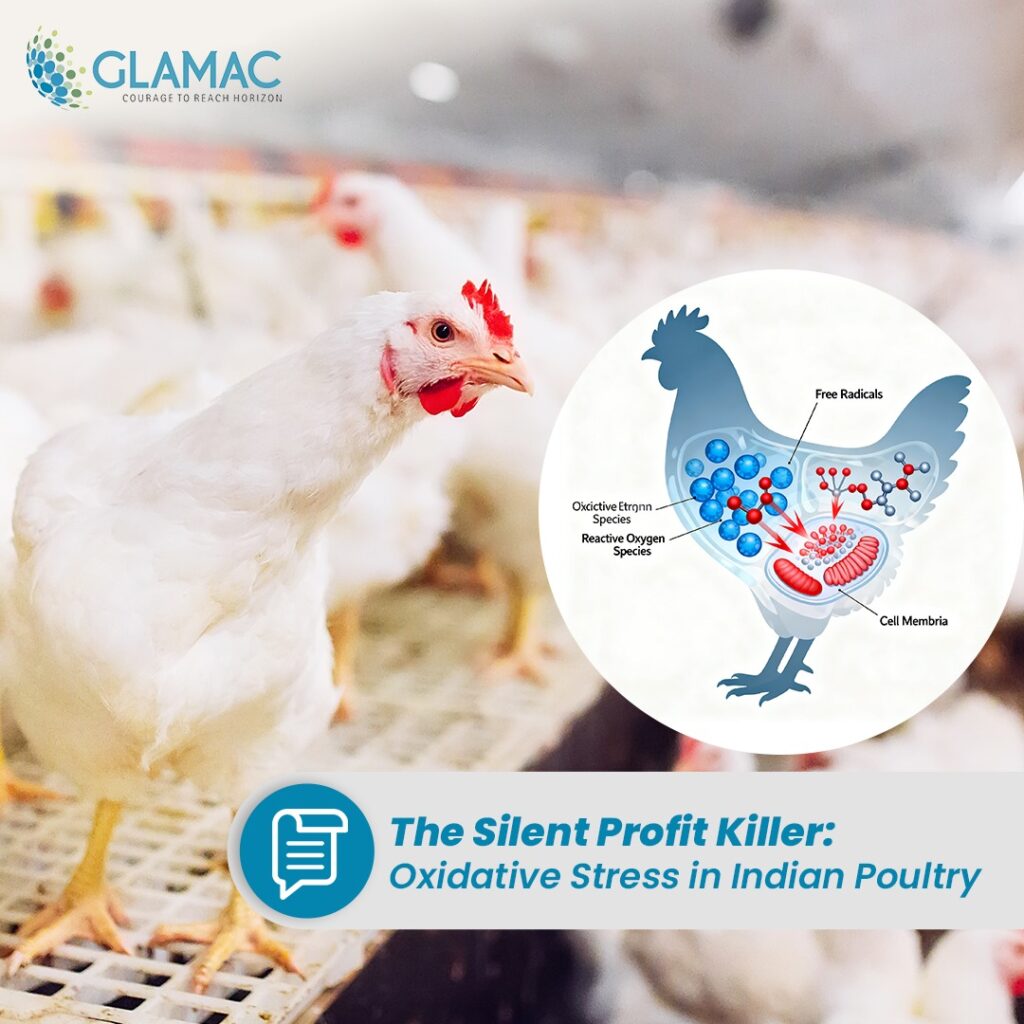
At its simplest, oxidative stress is a biological “imbalance”. Every chicken’s body naturally produces Reactive Oxygen Species (ROS)—which include molecules like hydrogen peroxide ($H_{2}O_{2}$) and hydroxyl radicals ($OH$)—as a byproduct of normal metabolism.
Under healthy conditions, the bird’s internal antioxidant defense system (enzymes like SOD and GPX) neutralizes these ROS. However, when stressors become too intense, ROS production sky-rockets, overwhelming the bird’s defenses and causing damage to vital cells, proteins, and DNA.
Key Sources of Stress on Indian Farms
- Thermal Challenge: India’s summer temperatures often exceed the “thermoneutral zone” of 18°C to 24°C. Since chickens lack sweat glands, they cannot easily dissipate heat, leading to massive ROS buildup.
- Mycotoxins: Fungal toxins in feed (Aflatoxins, Ochratoxins) are a major concern in India due to storage conditions. These toxins inhibit natural antioxidants and trigger lipid peroxidation.
- High Stocking Density: Crowding birds to maximize space can actually lower serum antioxidant capacity and increase malondialdehyde (MDA) levels—a key marker of cell damage.
- Pathogens: Infections like Avian Influenza or Newcastle Disease trigger an “oxidative burst” as the immune system tries to kill the virus, often causing collateral damage to the bird’s own tissues.
How Oxidative Stress Hits Your Bottom Line
Oxidative stress isn’t just a biological concept; it has a direct impact on the economic efficiency of a poultry operation.
-
Reduced Growth & Higher FCR
When a bird is under oxidative stress, it diverts energy away from muscle building toward “repair and maintenance”.
- Muscle Wasting: ROS can lead to protein degradation and muscle atrophy.
- Poor Nutrient Absorption: OS damages the intestinal lining (mucosa), meaning the expensive feed you provide isn’t being absorbed efficiently.
-
Compromised Meat and Egg Quality
- The “Wooden Breast” Problem: In fast-growing broilers, oxidative damage contributes to anomalies like white striping and wooden breast myopathy.
- Shelf Life: Meat from stressed birds has higher lipid oxidation, leading to “off-flavors,” rancid odors, and poor color, which reduces consumer appeal.
- Shell Integrity: For layer farmers, OS disrupts calcium metabolism, leading to thinner, weak-shelled eggs that are prone to breakage.
-
Fertility Issues in Breeders
Sperm cells are highly sensitive to ROS due to their high lipid content. Oxidative stress leads to DNA fragmentation in sperm, drastically reducing fertility and hatchability rates.
Mitigation Strategies: Practical Solutions for India
Combating oxidative stress requires a multidisciplinary approach combining better management with advanced nutrition.
Effective Management Tactics
- Environmental Control: Utilizing cooling fans, sprinklers, or evaporative cooling pads to keep house temperatures within the 18-24°C range.
- Feed Restriction: During peak heat hours, withdrawing feed can reduce the “thermal load” produced by digestion.
- Lighting Programs: Using monochromatic blue light has been shown to decrease MDA levels and boost antioxidant enzyme activity.
The Power of Phytogenics and Nutritional Additives
Modern research points toward Vitagenes (like Nrf2) as the “master regulators” of antioxidant defense. Activating these genes helps the bird produce its own protective factors.
| Strategy Type | Specific Additive | Mechanism of Action |
|---|---|---|
| Vitamins | Vitamins C & E | Scavenge free radicals and donate electrons to neutralize ROS. |
| Minerals | Zinc & Selenium | Act as cofactors for antioxidant enzymes; Selenium increases heat resistance. |
| Phytogenics | Resveratrol, Curcumin, Cinnamon, Ginger | Activate the Nrf2 pathway to stimulate internal ROS scavengers and reduce inflammation. |
| Amino Acids | Methionine & Arginine | Reduce muscle oxidation and improve the integrity of the gut barrier. |
The Future: Precision Poultry Farming
As we look toward 2026 and beyond, technology will play a larger role in managing stress on Indian farms.
- Sensor Integration: Automated systems can monitor humidity and temperature in real-time, adjusting ventilation before the birds even begin to pant.
- Genetic Resilience: Breeding programs are now focusing on selecting traits for “oxidative stress resistance” to create birds better suited for the Indian climate.
- Precision Feeding: Tailoring nutrient intake to the specific stress level of a flock can minimize waste and maximize the impact of expensive antioxidants.
Conclusion
Oxidative stress is an unavoidable challenge in modern poultry production, but it doesn’t have to be a profit drain. By understanding the triggers—like India’s harsh summers and feed toxins—and implementing a robust plan involving vitamins, phytogenics, and smart management, farmers can ensure their flocks remain healthy, productive, and profitable.
Reference
Oke, O. E., O. A. Akosile, A. I. Oni, I. O. Opowoye, C. A. Ishola, J. O. Adebiyi, A. J. Odeyemi, B. Adjei-Mensah, V. A. Uyanga, and M. O. Abioja. (2024). “Oxidative stress in poultry production.” Poultry Science, 103(104003). https://doi.org/10.1016/j.psj.2024.104003.